
Why This Shift Happened
Cloud spend is variable and unpredictable. Digital transformation ROI is harder to measure than on-premises infrastructure. Regulatory scrutiny of technology investment has increased. Board technology committees are asking harder questions about IT value. All of these forces elevated the CFO's role in IT decision-making.
What CFOs Actually Care About
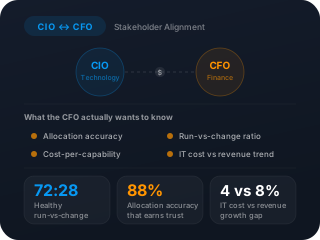
CFOs do not care about IT headcount, infrastructure specs, or vendor choices. CFOs care about:
- Allocation accuracy — can you prove what IT costs?
- Run-vs-change ratio — how much budget is locked in maintenance?
- Cost-per-capability — what does each IT service cost?
- Trend — is IT cost growing faster or slower than revenue?
If you say 'our IT budget is $200M,' the CFO has no frame of reference. If you say '$200M, 72% run cost and 28% change investment, allocation accuracy at 88%, IT cost growing at 4% while revenue grows at 8%,' the CFO can evaluate whether that is healthy.
Three Things Every CIO Must Do Now
Speak finance
OpEx vs CapEx. Allocation methodology. Cost-per-service.
Report monthly
The CFO operates monthly. Annual reports make you invisible.
Reframe IT
An investment portfolio with returns — not a cost constraint.
One — Speak financial language. Learn OpEx vs. CapEx. Understand allocation methodology. Defend cost-per-service numbers. Stop using IT jargon.
Two — Produce cost data monthly, not annually. The CFO operates monthly. If you cannot provide current data on a monthly cycle, you are invisible to CFO decision-making.
Three — Present IT as an investment portfolio, not a cost constraint. Do not say 'we need a larger IT budget.' Instead say 'we have investment opportunities in three areas; here is the cost of each, the expected return timeline, and the business risk if we don't invest.'
The New CIO–CFO Dynamic
The CIO who sees the CFO as a partner — not an adversary — wins the next five years. CFOs bring financial discipline, accountability standards, and board credibility. CIOs bring technology capability and digital transformation roadmap. Together, they make better investment decisions than either could make alone.
“Our CIO started showing me monthly cost data broken down by service and business unit. Suddenly I could see what was working and what wasn't. That visibility made us partners instead of adversaries.”
— CFO, mid-size financial services firm