
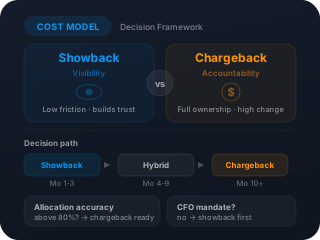
The Showback Model: Visibility Without Accountability
Showback means business units see their IT costs but do not pay for them from their own budgets. The costs remain in the central IT pool. Showback is the starting point for most organizations moving from cost opacity to transparency.
Benefits. Low political friction, forces discipline on cost data quality, builds business unit understanding of what IT actually costs.
Risks. Without financial accountability, business units can ignore the costs and continue consuming inefficiently.
The Chargeback Model: Full Accountability
Chargeback means business units pay for their IT costs from their own budgets. If you consume more IT resources, your budget gets larger. This creates powerful incentives for consumption optimization.
Benefits. Business units optimize ruthlessly, IT becomes a cost center with transparent pricing, shadow IT proliferation stops.
Risks. Political backlash in Year 1, requires strong allocation methodology, requires exception process.
The Hybrid Model: The Path Most Organizations Take
Hybrid means mandatory chargeback for consumption-based services (cloud, SaaS seats) but showback for shared platform costs (data center, core infrastructure, IT leadership). This is the model that works in practice.
Visibility, no accountability
Business units see what they consume but pay nothing from their own budgets. Optimization depends on goodwill alone.
Variable charged, fixed shown
Cloud and SaaS charged back to the BU. Shared platform shown. Accountability where consumption is decided.
The Decision Framework
CFO support
If the CFO won’t back chargeback, do showback only.
Accuracy
Below 80%? Build allocation accuracy first.
Governance
No IT investment committee? Showback first.
Change capacity
Low → showback. High → chargeback.
- Does your CFO want chargeback? If no, showback only.
- Is your cost allocation accuracy above 80%? If no, showback first.
- Do you have documented IT Investment Committee decisions? If no, showback first.
- Are you ready for business unit objections? If no, consider hybrid.
- What is your change management capacity? Low = showback; medium = hybrid; high = chargeback.
Implementation Path
Phase 1 (Months 1–3). Showback only. Build cost accuracy, business unit reporting, dispute resolution.
Phase 2 (Months 4–9). Selective chargeback. Start with one variable-cost service.
Phase 3 (Months 10–18). Full hybrid model.
The timeline is critical: rushing to chargeback before showback is solid produces allocation disputes that undermine the entire program.
“We started with showback. Within 6 months, business units started asking questions about why their costs were higher than other departments. That question-asking drove optimization without us having to impose it.”
— VP of IT Finance, financial services firm