
The FinOps Blind Spot
FinOps is brilliant at finding cloud waste: idle resources, mismatched instance types, commitment underutilization, unnecessary redundancy. A mature FinOps program can identify 15–30% of cloud spend as optimizable and realize 8–15% savings.
But FinOps answers a narrow question: 'How do we reduce our cloud unit cost?' It does not answer the question that matters for business investment decisions: 'Which business process is consuming that cloud cost, and what is the business value we get from it?'
The Consequence: Savings That Don't Stick
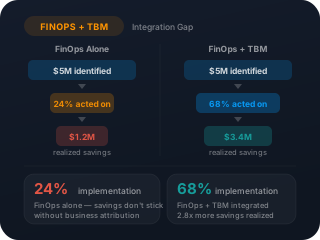
FinOps team identifies $5M in annual cloud savings. Cloud engineering team begins implementing. Six months later, only $1.2M has actually been realized. Why? Because the optimizations touch workloads owned by business units, and business units don't feel ownership of the savings.
The Integration Solution: FinOps + TBM
The missing piece is business attribution. When FinOps identifies a cost reduction opportunity, the question should route to the business unit that owns the affected workload: 'We can reduce your cloud cost by $400K annually by optimizing your database. This changes nothing functionally. Approve or reject?'
With business attribution, the incentive structure inverts. The business unit becomes a participant in optimization, not a passive recipient. Cost savings feel like a business-unit win, not an IT imposition.
$5M identified, $1.2M realized
24% implementation rate. Optimizations touch BU workloads but BUs don’t feel ownership of the savings.
$5M identified, $3.4M realized
68% implementation rate. Recommendations route to the BU that owns the workload. Savings feel like a win, not an imposition.
The Numbers: Integration Matters
Organizations running FinOps alone: $5M opportunity identified; 24% implementation rate; $1.2M realized.
Organizations running FinOps + TBM integrated: $5M opportunity identified; 68% implementation rate; $3.4M realized.
The difference is business unit engagement.
“We had a FinOps team optimizing cloud beautifully. But half the recommendations never made it to implementation because business units didn't feel ownership of the result. When we integrated FinOps recommendations with TBM business attribution, our implementation rate jumped from 24% to 68%.”
— CIO, technology company