
When Good Data Lives in the Wrong Places
Modern IT environments are complex by nature. Cloud infrastructure, on-premises systems, acquisitions, legacy platforms — each one generates its own data, stored its own way, labeled in its own language. The challenge isn't knowing what you need. It's assembling it reliably enough to act on.
IT professionals spend enormous time pulling data from disconnected sources: ticketing systems, asset databases, ERP platforms, spreadsheets — just to answer basic operational questions. Want to know storage utilization by application? You'll need server data, storage data, cloud data, and a way to tie them all together. Want to understand the impact of an application outage? That answer lives across a dozen systems that were never designed to talk to each other.
The result is familiar to anyone who has lived it: data gets approximated. Assumptions layer on top of assumptions. Reports get produced — polished, well-formatted reports — that eventually invite questions no one can fully answer. Trust erodes. Relationships between IT teams and business stakeholders, or between IT departments and their service providers, begin to fray. Not because anyone lacks competence, but because the data foundation underneath those relationships was never solid.
We call this the cost of dysfunction. And in our experience working with large enterprises, it isn't theoretical. Billing disputes that should resolve in hours drag on for weeks. Provisioning cycles stall because no one can agree on utilization figures. Financial planning proceeds on numbers that three different teams calculated three different ways. The organizational friction created by bad data compounds over time — and the enterprises carrying the largest IT estates carry the largest cost of dysfunction.
Meeting You Where You Are
The "Fog" in FogLifter® stands for Frequency of Garble — a name that reflects the real experience of IT professionals navigating a landscape of mismatched, siloed, and inconsistent data. We chose it deliberately, because naming the problem is the first step toward solving it.
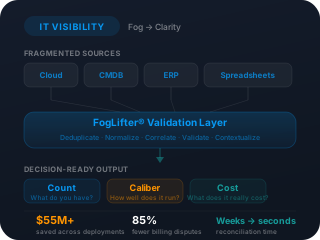
FogLifter® doesn't ask you to transform your environment before it can help. It meets you where you are. That means connecting directly to your existing systems of record — cloud infrastructure, on-premise servers, SQL databases, spreadsheets, legacy tools — and bringing that data together in a platform purpose-built for IT operational intelligence.
From there, it deduplicates, normalizes, correlates, and validates the data so that what surfaces is accurate, traceable, and trustworthy. We do extract, load, then transform — and the transform happens through an ontology engine that understands IT systems at a semantic level. It knows that a Hitachi® storage line is labeled differently than a Dell™ EMC line. It knows that allocated storage and consumed storage are different numbers, and that confusing them has consequences. It doesn't just move data — it contextualizes it.
The process is deliberate: source by source, win by win. As data is validated and connected, your team gains a reliable picture of what you actually have, what it costs, how it performs, and who owns it. And everyone can see exactly where that data came from.
Fragmented data, approximated answers
Each system of record speaks a different language. Reconciliation is manual, periodic, and contested. Reports invite more questions than they answer.
Validated data, decision-ready answers
A single reconciled record across 75+ enterprise data sources. Every number is traceable to its origin. Disputes resolve in days, not weeks.
The Real Cost of Not Knowing
When I talk with IT leaders about what motivated them to look for a solution like FogLifter®, the stories are remarkably consistent. It's rarely one catastrophic failure. It's the accumulation of small frictions — what I sometimes call the death of a billion cuts.
A business unit questions a chargeback bill. The infrastructure team and the finance team pull numbers from different systems and arrive at different figures. Someone opens a spreadsheet to reconcile the two. Three people spend four days tracking down the discrepancy. They eventually resolve it, but next month, it happens again — because nothing in the process changed.
"We have plenty of tools. We just don't know the numbers."
— A sentiment we hear consistently from enterprise IT leaders evaluating FogLifter®
At scale, this isn't a minor inconvenience. One enterprise customer was routinely disputing 3,000 to 5,000 servers every single month — between 7% and 10% of their entire production environment — because their team and their service provider were working from different counts. The cost wasn't just the billing discrepancy itself. It was the organizational effort spent relitigating numbers that should never have been in dispute in the first place.
These are the dynamics that motivated us to build FogLifter®. Not to add another reporting layer on top of what already exists, but to eliminate the conditions that make those disputes possible.
A Foundation for AI That Actually Works
AI is generating enormous interest in enterprise IT right now, and rightly so. Natural language query tools and large language models can produce extraordinary results — when the data they're operating on is trustworthy. When it isn't, they produce confident-sounding answers that nobody can verify and nobody should act on.
The bottleneck isn't the AI model. The models are extraordinary. The bottleneck is the data they're operating on. An NLQ tool without a validated data foundation underneath it is just another conversational interface sitting on top of whatever you happened to connect it to. It will give you answers. It will not give you correct ones.
FogLifter® serves as the data foundation layer that makes AI-driven IT analysis trustworthy. By cleaning, validating, and structuring your IT data upstream of any AI interface — before any question is asked — FogLifter® ensures that when you ask a question in plain language, the answer is grounded in operational evidence, not inference. We call this Grounded AI: NLQ built on reconciled data, not on whatever happened to get ingested.
Clarity Builds Confidence
When IT leaders have verified, comprehensive visibility into their environment, the downstream effects are significant and immediate. Conversations with business stakeholders become productive rather than defensive. Negotiations with service providers are grounded in shared, accurate data rather than competing spreadsheets. Strategic decisions around cost, capacity, risk, and performance can be made with confidence — because the numbers stop moving underfoot.
That shift in dynamic matters beyond the financial return. IT organizations that can defend their numbers earn a different kind of standing in the business. They stop being the team that gets questioned in every budget meeting and start being the team that other executives want in the room when strategy is being set.
In enterprise IT, trust is earned through evidence. FogLifter® provides that evidence — validated, reconciled, and traceable — across Count, Caliber, and Cost. Not because we replace what you already have, but because we give everything you already have a foundation it can actually stand on.
"In enterprise IT, trust is earned through evidence. FogLifter® provides that evidence — validated, reconciled, and traceable — across Count, Caliber, and Cost. Not because we replace what you already have, but because we give everything you already have a foundation it can actually stand on."
FogLifter® doesn't just produce reports. It produces trust. And in enterprise IT, trust is the currency that everything else depends on.