
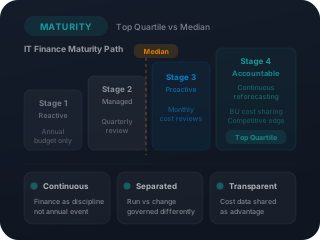
#1: They treat IT finance as a continuous discipline, not an annual event
Median. Budget cycle once per year; cost review quarterly.
Top quartile. Monthly cost reviews; continuous budget reforecasting; monthly business unit cost statements.
Annual budget · Quarterly review
Variances caught in month 6. On a $100M budget, $5M variance visibility.
Continuous reforecasting
Variances caught in month 1. On the same budget, $833K monthly visibility.
Consequence. Top quartile organizations catch and correct variances in month 1; median organizations in month 6. On a $100M budget, that's the difference between $833K monthly variance visibility and $5M.
#2: They separate run costs from change costs and govern them differently
Median. Single IT budget; one run-vs-change conversation per year.
Top quartile. Run budget fixed for the year; change budget reviewed monthly and reforecasted quarterly.
Consequence. Run work is predictable; change capacity is visible and redeployable.
#3: They make cost transparency a competitive advantage, not a compliance obligation
Median. Produce cost data because they must; data goes to IT and CFO only.
Top quartile. Produce cost data and actively share it with business unit leaders, product managers, and board.
Consequence. Business units see their IT costs monthly; make consumption decisions accordingly; optimization happens naturally.
The Path
Year 1
Build cost visibility. TBM platform, data integration.
Year 2
Build allocation accuracy. Methodology validation, BU engagement.
Year 3
Build continuous governance. Monthly cadence, BU partnership.
Outcome at Year 3: Full Stage 4 (‘Accountable’) IT finance maturity. Every top-quartile organization started somewhere. The difference is they decided to invest.
“IT financial maturity is not about perfection. It's about intentionality. The top-quartile organizations simply decided this was important and invested accordingly.”
— IT Finance Director, Global Fortune 500