
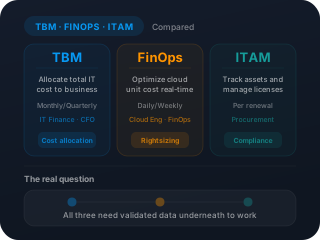
TBM (Technology Business Management)
- What: Allocates total IT cost to business services and business units.
- Who: IT Finance, CFO's office.
- Timeframe: Monthly or quarterly.
- Answers: ‘What does it cost to support this business capability?’
- Uses: Budget allocation, chargeback, cost-per-capability reporting.
FinOps (Cloud Financial Operations)
- What: Optimizes cloud unit costs in real-time.
- Who: Cloud engineers, FinOps team.
- Timeframe: Daily or weekly.
- Answers: ‘How do we reduce our cloud spend?’
- Uses: Reserved instances, rightsizing, commitment optimization.
ITAM (IT Asset Management)
- What: Tracks physical and software assets; manages licenses.
- Who: Procurement, IT Asset Manager.
- Timeframe: Per procurement, per renewal.
- Answers: ‘Do we own this? Are we licensed for this?’
- Uses: License compliance, asset tracking, procurement control.
TBM Allocates total IT cost to business services. Monthly. Owned by IT Finance.
FinOps Optimizes cloud unit cost in real time. Daily. Owned by Cloud Engineering.
ITAM Tracks assets and licenses. Per renewal. Owned by Procurement.
The Relationship
TBM needs ITAM data (SaaS inventory) and FinOps data (cloud costs). FinOps needs TBM context (which business unit benefits from this cloud cost reduction?). ITAM needs TBM (what is the total cost of ownership of this asset?). All three are necessary; none is sufficient.
Common Mistakes
- Buying a FinOps tool and expecting it to solve TBM problems (it won't).
- Building TBM without cloud cost integration (your biggest cost category goes unmeasured).
- Running ITAM without TBM (you know you own the asset but not what it costs to maintain).
All three are necessary TBM needs ITAM data and FinOps data. FinOps needs TBM context. ITAM needs TBM for total cost of ownership. None is sufficient on its own.
“TBM, FinOps, ITAM. If you're only doing one, you're missing 2/3 of the picture.”
— CIO, Fortune 500 technology company