
She asked the new query tool why before the meeting, and it gave her a clean, specific answer. The IT Finance analyst across the table has a different number, from a different report, and neither of them can say, in the room and on the spot, which is right. Everything that made this meeting go badly happened months earlier, and none of it involved AI.
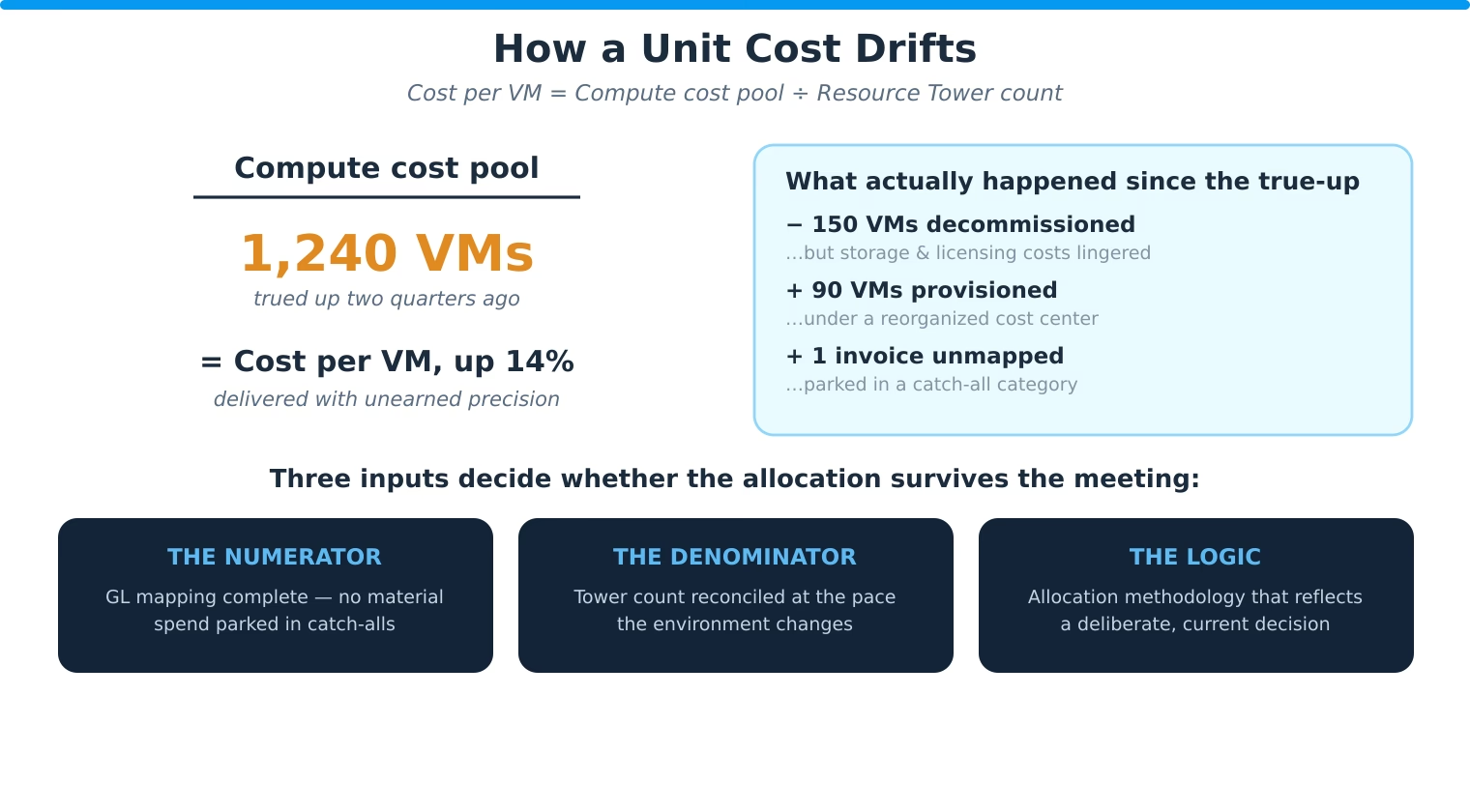
Walk the number backward. Cost per VM is an allocation: a Compute cost pool divided by a Resource Tower count. The count in the formula was trued up two quarters ago at 1,240 virtual machines. Since then, roughly 150 VMs were decommissioned and 90 new ones were provisioned under a different cost center, but the formula still divides by 1,240. The numerator moved too: the decommissioned machines released less cost than expected because their storage and licensing lingered, and an invoice from the reorganized cost center landed in a catch-all category, unmapped. Every input drifted a little. The output drifted enough to start a dispute.
Three Inputs That Decide Whether an Allocation Survives
- The numerator: GL mapping complete enough that no material spend sits parked in a category the formula distributes by default.
- The denominator: a tower count current enough that per-unit math reflects what is actually deployed, which in most programs means reconciled far more often than the annual or semi-annual true-up allocations traditionally received.
- The logic: an allocation methodology that reflects a deliberate, current decision rather than an exception inherited from a prior taxonomy version that nobody has revisited.
What changed is not the math but the audience. When allocations lived inside analyst-built quarterly reports, the analyst's own skepticism was a quality gate: they knew which categories drift and rechecked them before publishing. Self-service query removes that gate. The same drifted allocation now reaches the person with the strongest motivation to challenge it, formatted with a precision it has not earned.
FogLifter® treats this as a continuous-validation problem rather than a periodic true-up. The Cost pillar of the Count, Caliber, and Cost framework validates ERP, HR, and asset management data so unidentified spend is surfaced rather than silently distributed, while Count keeps tower denominators reconciled against systems of record on an ongoing cadence. The operational proof of that cadence: one FogLifter® deployment generates more than 60 invoices monthly across 200-plus resource units, billed within one week of close, a pace that is simply impossible when allocation inputs need manual rescue every cycle.
The dispute in that meeting was never really about a 14 percent jump. It was about whether anyone in the room could trace the number. Make the trace instant, and a dispute becomes a conversation. Leave it to archaeology, and every chargeback line is a future argument.
The whitepaper behind this blog
For a deeper look at the validation framework and a step-by-step pre-launch checklist, read the full whitepaper: The AI Readiness Assessment for TBM Programs.
Frequently Asked Questions
Match the reconciliation cadence to the query cadence. Data reviewed quarterly can tolerate quarterly true-ups; data business users can query on demand needs continuous or near-continuous reconciliation, because any gap between reality and the denominator is now instantly visible.
The denominator. Unidentified spend eventually gets audited because Finance reviews the numerator, and allocation logic changes rarely, but tower counts drift constantly as environments change, and most programs true them up far less often than the environment moves.
No; it validates the inputs your methodology depends on. Allocation logic remains a business decision. FogLifter® ensures the GL mapping and tower counts flowing into that logic are reconciled against systems of record and traceable on demand.
Related Resources
Continue reading on connected topics from FogLifter®.