

Token-metered AI consumption does not respect that boundary. It is variable like cloud spend, so FinOps claims it. It is enterprise technology spend that needs forecasting and governance, so ITFM has to own it. And it arrives on invoices most GL mappings cannot classify, so in practice neither discipline counts it well. This post takes the finops vs ITFM question seriously as a data problem, because that is where it gets decided.
FinOps optimizes a Cost Pool; ITFM owns the ledger
The Technology Business Management (TBM) Taxonomy locates each discipline precisely. FinOps is engineering-led, in-cycle optimization of variable cloud consumption, and its territory maps to the Cloud Services Cost Pool, which the TBM Council's own practitioner guidance positions as the structural bridge between FinOps optimization and finance-led financial management (the CFO's guide). ITFM spans every pool at once: Staffing, Hardware, Software & SaaS, Outside Services, and Cloud Services together, on close and forecast cadence rather than engineering cadence. Same structure, different span, different clock speed.
The estate a cloud bill never shows
The span difference matters because of what never appears on a cloud bill: data centers, enterprise licensing, labor, hardware refresh, vendor services. For many enterprises that remains the larger share of the technology ledger, and to cloud-only tooling it reads as zero. Not free, dark. A FinOps practice promoted into the IT finance role by adding a budget module inherits that darkness, and the CFO's first question about total technology spend lands in it. Cloud cost discipline is necessary. On a hybrid estate it is nowhere near sufficient, which is an argument made from the cloud bill's side in an earlier piece (FinOps is not enough). This post makes it from the ledger's side.
Take one concrete pool as the illustration: Staffing. Internal labor is one of the largest Cost Pools in most enterprise technology ledgers, it never appears on a cloud bill, and its allocation into Resource Towers is what turns a platform team's payroll into the true cost of the platforms they run. A discipline that cannot see Staffing cannot answer the questions the CFO actually asks, starting with what does this application really cost us, because the answer is usually more labor than infrastructure. That is not a knock on FinOps, which never claimed the Staffing pool. It is a scope fact about what the cloud bill is.
Token-metered AI: claimed by both, counted by neither
Now add the new spend class. Token-metered AI consumption is billed per token, at rates that vary by model and by vendor, on invoices that arrive as aggregated API line items with none of the workload context that allocation requires. It scales with usage like cloud spend, so it behaves like FinOps territory. It is becoming a material, board-visible commitment that needs forecasting and governance, so it is unavoidably ITFM territory. It is both, which in most organizations means it is effectively neither.
The cadence conflict makes it worse. FinOps sees the consumption signal daily and can throttle, cache, or reroute workloads in-cycle, but it optimizes inside the invoice, not across the ledger. ITFM sees the invoice at close, weeks after the consumption decisions were made, and locks forecasts on a quarterly rhythm the spend does not respect. By the time a token volume spike reaches the variance report, the engineering decisions that caused it are two sprints old. Neither cadence is wrong. They are answering different questions, and the spend class needs both answered from the same count.
The discipline gap is measurable. The TBM Council reports an 80 percent versus 33 percent gap in AI cost planning: 80 percent of TBM practitioners report having a clear plan to manage AI costs, compared to just 33 percent of organizations operating without TBM. That is the Council's finding about structured practice, not a tool claim, and it points at the same conclusion this post argues: the organizations that can plan AI cost are the ones whose counting structure already has a place to put it.
The Cost Pool an API invoice lands in depends on who bought it
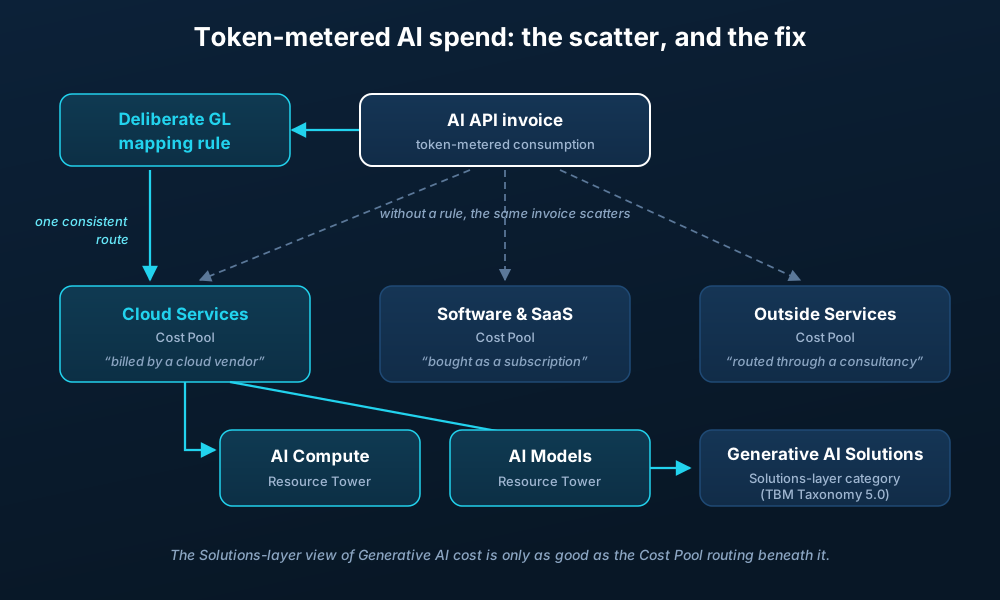
Here is the concrete failure. One business unit consumes a model through the cloud provider's platform, and the invoice lands in Cloud Services. Another buys the same vendor's offering as a subscription through procurement, and it lands in Software & SaaS. A third routes it through a consulting agreement, and it lands in Outside Services. Same model, three procurement paths, three Cost Pools. The GL mapping rules were written before this spend class existed, so each path follows its own legacy rule, and the spend scatters.
Everything downstream inherits the scatter. TBM Taxonomy 5.0 built the destinations for this spend: AI Compute, AI Storage, and AI Models in the Resource Towers layer, and Generative and Agentic AI solution categories in the Solutions layer (TBM Taxonomy 5.0.1). But Tower allocation cannot reassemble what GL mapping scattered, so the AI Towers undercount, and the Solutions-layer view of Generative AI total cost of ownership is wrong from the day it is built. Populating the structure the Council designed takes two unglamorous things: a deliberate GL mapping rule that routes API consumption consistently, and validated invoice data underneath it, which is exactly the layer FogLifter® works at, reconciling cloud billing, GL, and asset data into one validated foundation (what the platform connects to).
The estate is hybrid, so the counting has to be
The finops vs ITFM question resolves the way most boundary disputes do: at the property line, which here is the data foundation. Keep FinOps at engineering cadence inside Cloud Services. Keep ITFM on the whole ledger. Let both read from one validated count, and the new spend class becomes a mapping rule instead of a turf war. This week: pull every AI API invoice from the last quarter and list which Cost Pool each one landed in. If the answer is more than one, the boundary dispute is live in your ledger, and neither discipline's dashboard is going to warn you. For the evaluation framework behind that, see the anchor whitepaper.
See what a validated foundation does for hybrid spend: spend optimization with FogLifter.
The whitepaper behind this blog
For the full evaluation framework and the five counting tests, read the anchor whitepaper: What IT Financial Management (ITFM) software actually has to do.
Frequently Asked Questions
FinOps is engineering-led optimization of variable cloud consumption, operating in near real time and mapping to the Cloud Services Cost Pool. ITFM is finance-led planning, tracking, and governance of the entire technology ledger, on close and forecast cadence. They differ in span and clock speed, not in importance, and both depend on the same validated cost foundation.
No. FinOps covers the cloud bill, and on a hybrid estate the cloud bill is only part of the ledger. Data centers, labor, enterprise licensing, hardware, and vendor services never appear on it. An organization that treats FinOps as its IT finance function loses visibility into everything outside the Cloud Services Cost Pool, which is usually the larger share.
The Cloud Services Cost Pool, which the Taxonomy dedicates to cloud consumption precisely so its variability can be isolated, forecast, and bridged into enterprise financial management. Keeping cloud spend in its own pool lets FinOps optimize inside it while ITFM contextualizes it against fixed on-premises and labor costs in the same model.
Start by getting the spend into one place. A deliberate GL mapping rule routing API consumption to a single Cost Pool, on validated invoice data, is the precondition; scattered spend cannot be forecast because it cannot even be totaled. From there, volume-driven forecasting against the AI Resource Towers works the way capacity forecasting always has: usage history, growth assumptions, and rate assumptions kept explicit.
AI Compute is a Resource Tower introduced with TBM Taxonomy 5.0 for specialized compute optimized for AI and machine learning workloads, such as GPU-based servers, alongside AI Storage and AI Models. Together they give AI spend a dedicated structural home in the Towers layer, so its total cost can be assembled instead of dissolving into general infrastructure categories.
Related Resources
Continue reading on connected topics from FogLifter®.