

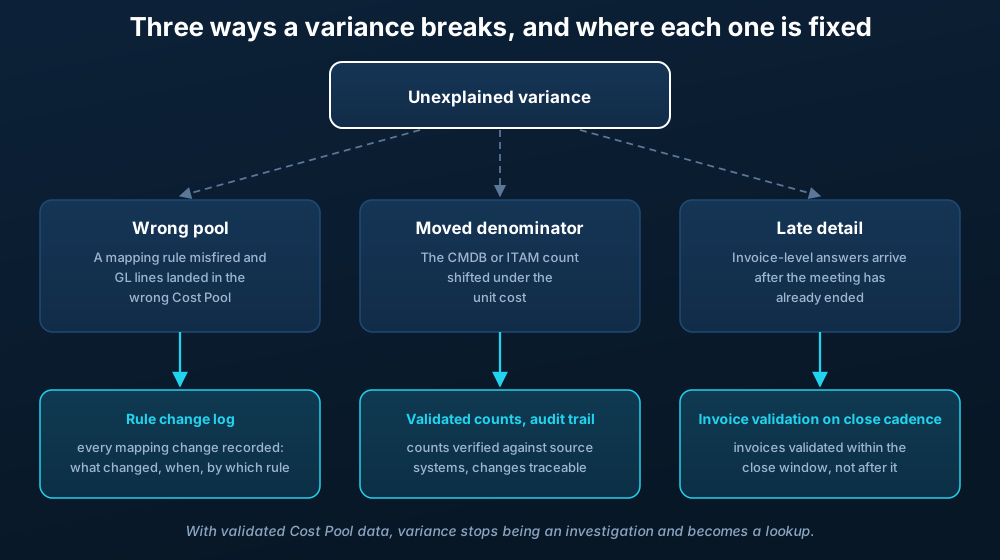
Here is the thing about it budget variance that the reporting templates never say: an unfavorable variance is survivable, and an unexplainable one is not, because an unexplainable variance tells the CFO the number could be wrong in either direction. Variance meetings do not die from bad news. They die from three specific failures, each of which traces to the data under the report, and each of which has a fix.
Failure one: the variance is real but sits in the wrong Cost Pool
Mapping drift moves money between Cost Pools without anyone spending differently. A renewed contract picks up a new vendor rule and jumps from Software & SaaS to Outside Services. A rebuilt cost center tree strands six months of history. The plan was built against last year's mapping rules, the actuals arrive on this year's, and the variance line reports the difference between two rule sets, not between plan and reality. The room then spends 20 minutes explaining a spend change that never happened.
The current instance of this failure is AI spend. Token-metered API invoices land in whichever Cost Pool each procurement path's legacy rule sends them to, so one pool spikes while another undershoots and the net story is invisible. The scatter itself is a topic for its own post; the variance symptom belongs here. The fix is a mapping-rule change log, treated as seriously as a code change log, and a plan re-based against current rules before the meeting, so the report separates rule movement from spend movement.
Re-basing sounds heavier than it is. It means running the plan's spend through the current rule set once, before the meeting, and publishing the reclassification as its own line: this much of the variance is rule movement, dated and attributed, and the remainder is real. Ten minutes of preparation converts the worst kind of variance conversation, the one about whether the categories mean anything, into the useful kind, the one about spending. CFOs forgive category changes that are disclosed. They do not forgive discovering them mid-meeting.
Failure two: the denominator moved and nobody logged it
The second failure lives in the counts. Allocated Resource Tower costs and unit costs ride on denominators: servers from the CMDB, licenses from ITAM, capacity from the arrays. When decommissions go unrecorded or license reconciliation slips, the counts drift, and allocated cost moves while actual spend stays flat. The variance meeting then chases a phantom: Tower cost per unit rose, nobody spent more, and no GL line explains it because no GL line caused it.
Unit costs amplify the same defect. Cost per virtual machine, per terabyte, per seat: every one of them carries a count in the denominator, and a drifted denominator moves the unit cost without moving a dollar. If those unit costs feed showback, the drift becomes a business unit's problem too, and the variance meeting acquires new attendees with less patience. Denominator integrity is not an infrastructure hygiene topic. It is a finance topic wearing an infrastructure costume.
The fix is validated counts with an audit trail: what changed, when, and against which source system. This is the layer FogLifter® works at. Its Validation View reconciles the CMDB, ITAM, and invoice data before counts become denominators, which means a moved denominator arrives in the meeting as a logged event with a date, not a mystery (how that looks in practice).
Failure three: the detail arrives three weeks after the question
The third failure is latency. The variance is flagged in the meeting, the invoice detail gets requested from accounts payable, and the answer arrives after the next forecast has already locked. The variance was explainable, just not while anyone still cared. Close-cycle speed is not a vanity metric here; it is the difference between a variance conversation and a variance archaeology project.
Validated, in this context, means more than received. An invoice that has been matched against its contract terms, its purchase order, and the consumption it claims to bill is a variance answer waiting to be asked for. An invoice that has merely been paid is a liability with a date on it. The difference between the two is the difference between the meeting ending with next question and ending with we will get back to you.
Speed at that step is achievable. At one FogLifter deployment, 60+ monthly invoices are validated within one week of close. That is one deployment's figure, not a benchmark, and redesigning the close process contributed alongside the tooling. It is quoted here as an existence proof: invoice-level answers can arrive while the question is still being asked.
What changes when the Cost Pool data is validated
With validated data underneath, the meeting inverts. Variance stops being an investigation and becomes a lookup: this rule changed on this date, this count moved against this source, this invoice says this. The CFO relationship compounds from there, because trust is built one survived challenge at a time, and the partnership case has its own dedicated piece (the CFO as stakeholder). The budget context favors moving now: the Technology Business Management (TBM) Council's State of TBM 2025 reports that 76 percent of organizations plan to invest more in data quality management over the next one to three years (State of TBM 2025). The CFO across the table is likely already funding this fix somewhere in the enterprise. The open question is whether IT finance is where it lands.
Decompose one variance before the next meeting
The pattern across all three failures is the same: it budget variance is only as explainable as the Cost Pool data underneath it, and the meeting fails at the data layer long before it fails in the room. This week, take last quarter's three largest variance lines and try to decompose each one to specific GL lines and count changes. Time yourself. However long it takes is what the CFO is currently waiting, and shortening it is a data project, not a slide project. The anchor whitepaper covers how to evaluate tooling for exactly that.
See invoice-level validation on a close calendar like yours: invoice validation with FogLifter.
The whitepaper behind this blog
For the full evaluation framework and the five counting tests, read the anchor whitepaper: What IT Financial Management (ITFM) software actually has to do.
Frequently Asked Questions
IT budget variance analysis compares actual technology spend against plan, usually at the Cost Pool level, and decomposes the differences into their causes: spend changes, mapping rule changes, and count changes. The decomposition is the analysis; a variance number without a traceable cause is a report, not an explanation, and CFOs can tell the difference immediately.
Decompose it before the meeting. Name the GL lines that moved, the Cost Pool reclassifications caused by rule changes, and the count changes that shifted allocations, each with a date and a source. CFOs accept unfavorable variances routinely; what they do not accept is a number nobody can walk back to the ledger while the question is still on the table.
Three things: actual spend changes in the Cost Pools feeding the Tower, allocation driver changes such as server or capacity counts moving, and mapping rule changes that reclassify spend between pools. The second and third produce variance with no spending cause, which is why unvalidated counts and unlogged rule changes generate the variances nobody can explain.
GL mapping decides which Cost Pool every ledger line lands in, so a rule change moves money between pools without any change in spending. If the plan was built on old rules and actuals arrive on new ones, the variance report measures rule drift, not performance. Re-basing the plan against current rules separates the two before the meeting does it the hard way.
Fast enough that variance questions can be answered while they are still being asked, which in practice means inside the close cycle rather than weeks after it. As an existence proof rather than a benchmark: at one FogLifter deployment, 60+ monthly invoices are validated within one week of close, with process redesign contributing alongside the tooling.
Related Resources
Continue reading on connected topics from FogLifter®.