

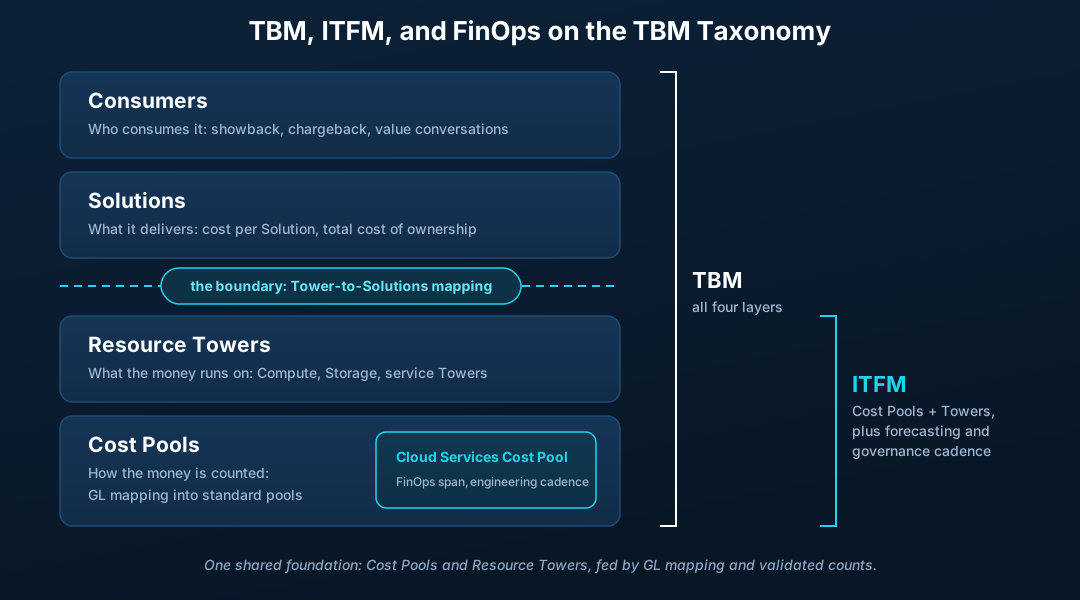
They are different spans of the same structure, the Technology Business Management (TBM) Taxonomy, and the boundary between them sits at a specific place in it: the top of the Resource Towers layer. Below that line, the two disciplines are doing the same work. Above it, TBM keeps climbing and ITFM hands off. This post draws that map layer by layer, then closes with what the boundary means when you are buying tooling that claims to serve both.
The shared foundation: Cost Pools and Resource Towers
Both disciplines start in the same two layers. GL mapping classifies every ledger line into a Cost Pool, and driver-based allocation attaches those pools to Resource Towers, where the money meets the infrastructure and services that consumed it. This is load-bearing structure for both: every downstream number either discipline publishes, an ITFM variance line or a TBM unit cost, inherits the accuracy of these two layers.
That inheritance is the practical argument for treating the foundation as one thing rather than two. When a mapping rule misfires and a renewal lands in the wrong Cost Pool, the ITFM variance report and the TBM Solutions-layer cost are wrong together, from the same root cause. Two disciplines, one defect. Organizations that run separate counts for each discipline do not get two chances to be right; they get two versions of the same error that no longer match each other.
The boundary question therefore starts as an ownership question. Somebody has to own the shared layers: the mapping rules, the allocation drivers, the reconciliation of counts against the CMDB and ITAM. In organizations where the TBM office owns them, ITFM consumes a foundation it trusts. In organizations where each discipline maintains its own extract of the GL, the foundation is owned by nobody and defended by everybody, one meeting at a time. Deciding who owns the two shared layers is worth more than most tool decisions, and it costs nothing but a conversation.
Above the line: TBM's Solutions and Consumers layers
TBM continues where ITFM's core reporting stops. Tower-to-Solutions mapping, the allocation step most commonly broken in practice, carries Tower costs into the Solutions layer, where they become the total cost of the things the business actually recognizes: applications, platforms, delivered services. The Consumers layer completes the climb, attributing Solution costs to the business functions and consumers that use them, which is where showback and chargeback live and where unit cost gets a denominator the business cares about.
Why is Tower-to-Solutions mapping the step that breaks? Because it depends on infrastructure-to-application relationships, and those live in the same CMDB whose counts ITFM already leans on for allocation drivers. Validate that data once and both the Tower allocation and the eventual Solutions climb stand on it. Leave it unvalidated and the boundary between the disciplines becomes academic, because neither side of it holds.
The climb is where the payoff concentrates. The TBM Council's State of TBM 2025 found that organizations that embed TBM deeply into decision making, its Deep Divers, deliver a Deep Diver impact of 3x to 7x across cost, performance, innovation, and change compared to low-maturity practices (State of TBM 2025). Read structurally, that multiplier lives above the shared line: it comes from the Solutions and Consumers layers that ITFM alone never climbs, sitting on the same Cost Pool and Tower foundation both disciplines need.
ITFM's span: the ledger, the forecast, and the close
None of that makes ITFM the junior discipline. Its remit is the one the CFO audits: budget, forecast, variance, and close, across every Cost Pool, on a cadence that does not slip. ITFM reads the Taxonomy bottom-up, money first and estate second, and it can do its whole job without ever running a chargeback. What it cannot do is run on unvalidated counts, because forecast credibility and variance decomposition both trace straight back to the shared layers. An IT finance director does not need the Consumers layer to survive a variance meeting. They need the Cost Pool data under the variance to be right.
The cadence is also what makes the discipline unforgiving. TBM's Solutions-layer conversations can wait for a better quarter to launch; the close cannot. Whatever state the mapping rules and the counts are in on the last business day of the month, that is the state the numbers publish in, and the CFO's calendar does not negotiate. This is why ITFM practices feel data defects before TBM practices do: the close is a monthly stress test of the shared foundation, run whether or not anyone prepared for it.
What the boundary means when you buy tooling
Three consequences follow. First, a platform serving either discipline has to be strong at the shared layers before anything else; the upper layers cannot repair a weak foundation, only decorate it. Second, two disconnected tools means two counts of the same money, which is the TBM vs ITFM boundary dispute internalized as a standing monthly meeting about whose number is right. Third, the boundary is also the upgrade path: an ITFM practice built on validated Taxonomy structure can extend into the Solutions and Consumers layers when the organization is ready, without re-platforming, because the layers above stack onto the layers below. That is the design premise behind FogLifter®: validate the data once, at the foundation, and let both disciplines read from it (how the platform fits an existing stack).
For how the two disciplines coordinate with ITAM in day-to-day operations, there is an existing piece on that triangle (TBM, FinOps and ITAM). This post is about the two-discipline boundary itself. If you are evaluating tooling against that boundary, the anchor whitepaper sets out the five counting tests that decide it.
Draw the line, then check both sides of it
The honest answer to TBM vs ITFM is a map, not a winner. Shared Cost Pools and Resource Towers at the base, ITFM spanning the ledger and the forecast, TBM climbing through Solutions and Consumers to value. This week, take one number that both your ITFM report and your TBM model publish, total Compute Tower cost is a good candidate, and check whether they agree. If they do not, the boundary dispute is already inside your stack, and the fix starts below both disciplines, at the data.
See what one validated foundation looks like: cost transparency with FogLifter.
The whitepaper behind this blog
For the full evaluation framework and the five counting tests, read the anchor whitepaper: What IT Financial Management (ITFM) software actually has to do.
Frequently Asked Questions
No. They share the same foundation, Cost Pools and Resource Towers fed by GL mapping, but they span different amounts of the TBM Taxonomy. ITFM covers financial planning, tracking, and governance of the full technology ledger. TBM extends the same structure through the Solutions and Consumers layers to connect cost with business value and consumption.
Four layers: Cost Pools, the financial classification of spend; Resource Towers, the infrastructure and service classification; the Solutions layer, the business-recognizable applications, platforms, and services; and the Consumers layer, the business functions and consumers using them. Money flows upward through mappings between the layers, and each mapping inherits the accuracy of the one below it.
No. ITFM runs on the Cost Pools and Resource Towers alone, and many organizations operate it that way for years. But building that foundation on the TBM Taxonomy rather than a proprietary schema keeps the upgrade path open: the Solutions and Consumers layers stack directly onto validated Cost Pool and Tower data when the organization is ready for them.
Tower-to-Solutions mapping is the allocation step that carries Resource Tower costs into the Solutions layer, turning infrastructure spend into the total cost of applications and services. It is the step most commonly broken in practice, because it depends on accurate relationships between infrastructure and the Solutions running on it, which is exactly where CMDB data tends to be weakest.
The foundation comes first, whichever name it wears. Validated GL mapping into Cost Pools and defensible Tower allocation serve both disciplines, and neither can compensate for their absence. Most organizations reach the Solutions and Consumers layers after the financial foundation is trusted, because showback and chargeback built on challenged numbers do not survive their first dispute.
Related Resources
Continue reading on connected topics from FogLifter®.