
Validating an entire Technology Business Management (TBM) model is a quarters-long program, and quarters-long programs lose to whichever AI pilot has an executive sponsor and a start date. The alternative is to give the work edges. What follows is a two-week sprint that takes one deliberately scoped slice of the model from unvalidated to pilot-ready, with a named owner and a time box for every step, because a checklist without owners is a wish list.
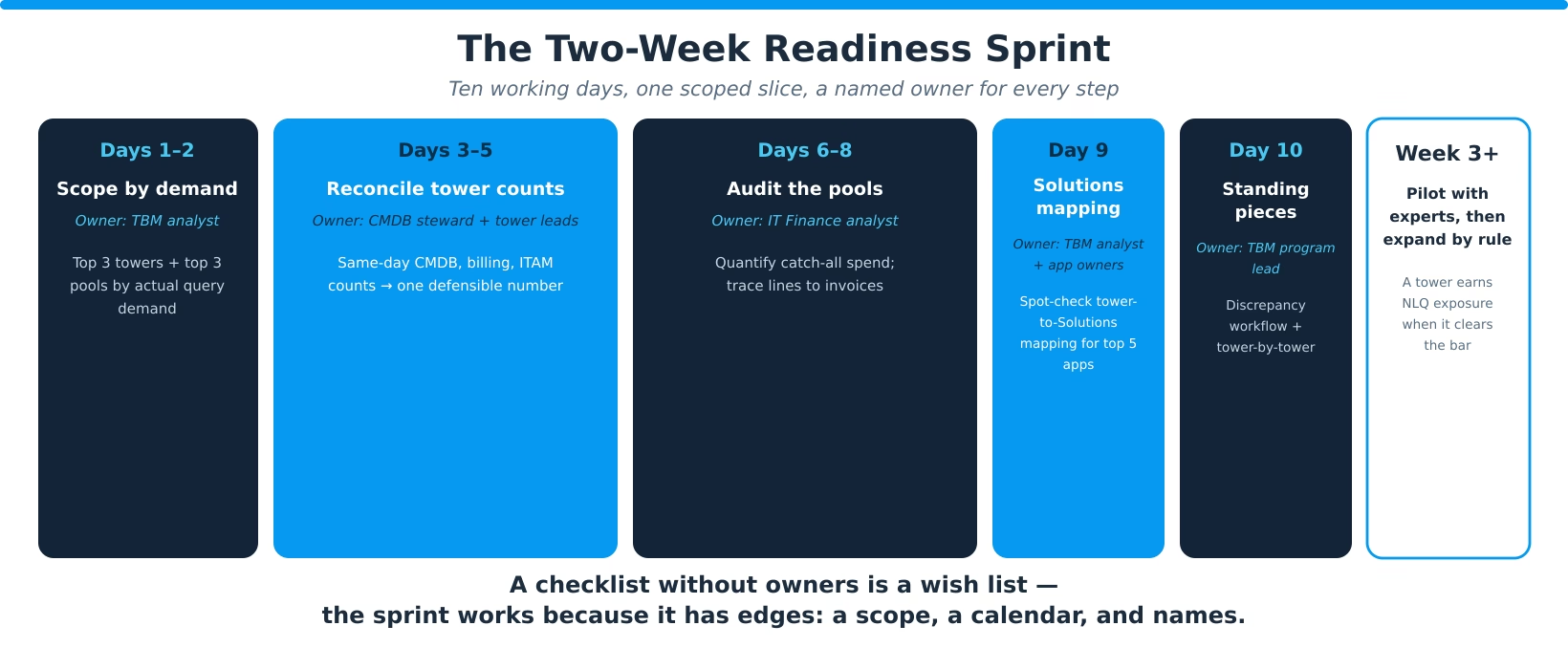
Ten Days, Named Owners
- Days 1–2: scope by demand. Owner: TBM analyst. Do not choose what to validate by guessing at risk. Pull the last 90 days of ad hoc reporting requests IT Finance has fielded and rank towers and cost pools by how often they are actually asked about. The top three towers and top three pools become the sprint's entire scope. Everything else is explicitly out.
- Days 3–5: reconcile the scoped tower counts. Owners: CMDB steward plus each tower lead. For each in-scope tower, pull same-day counts from the CMDB, billing feeds, and ITAM; resolve the discrepancies to a single defensible number; and record what was wrong in which system. This step is the sprint's center of gravity; if it takes longer than three days, the scope was too wide. Cut a tower, not a corner.
- Days 6–8: audit the scoped pools. Owner: IT Finance analyst. For each in-scope cost pool, quantify catch-all and unidentified spend, trace the largest line items to source invoices, and confirm the allocation formulas divide by the counts just reconciled on days 3–5, not by whatever the counts were at the last annual true-up.
- Day 9: spot-check the Solutions mapping. Owners: TBM analyst plus application owners. For the five applications most associated with the in-scope towers, verify the tower-to-Solution mapping is current. This is the single most common gap that real cross-layer queries expose, and one day of spot-checking covers the slice a pilot will actually touch.
- Day 10: stand up the standing pieces. Owner: TBM program lead. Two deliverables. First, a documented workflow for resolving new discrepancies as they emerge; without one, the sprint's validation decays within a quarter. Second, a visible confidence indicator, validated or not, tower by tower and pool by pool, so pilot users know exactly which questions the data is ready to answer.
Week three and beyond: pilot, then expand by rule. Open access to a small group who know the model well enough to recognize a wrong answer on sight. Treat every inconsistency they find as a validation gap to close, not an AI quirk to tolerate. And expand scope by a single rule: a tower or pool earns NLQ exposure when it has cleared the same bar the sprint set, never before, and never as a batch.
The whitepaper behind this blog
For a deeper look at the validation framework and a step-by-step pre-launch checklist, read the full whitepaper: The AI Readiness Assessment for TBM Programs.
Frequently Asked Questions
The scope. The sprint validates the three towers and three pools that receive the most actual query demand, not the whole model. Programs that fail at readiness usually failed at scoping, not at effort.
Narrow, don't extend. Drop the messiest tower from pilot scope, keep it in the standing remediation workflow, and launch the pilot on what cleared the bar. The sprint's promise is a defensible pilot scope, not a clean model.
People who know the TBM model well enough to recognize a wrong answer on sight: typically TBM analysts and one or two data-literate finance partners. Their job in week three is adversarial: find the gaps before a business leader does.
Related Resources
Continue reading on connected topics from FogLifter®.